Tuesday, April 19th, 2016
Ads Next is excited to announce that it’s dental marketing division, Dental Revenue is now an official Google Partner. This achievement recognizes our firm’s commitment to maintaining Google’s high standards.
“I’m proud of our team for earning this recognition,” said Brian Burns, president and founder of Ads Next. “Our company is dedicated to providing the highest level of marketing services to our clients. This partnership demonstrates our ability and opens the door for exclusive Google beta programs, training and marketing support.”
In 2014, Ads Next launched Dental Revenue, a division of the company devoted to dental marketing. Through this arm of the company, Ads Next has seen exponential growth and developed high level software and services to help dental practices increase revenue.
In just a few short years, Dental Revenue has earned a high reputation in the industry. Dental Revenue works with some of the dental industry’s leading dentists and dental organizations. Dental Revenue is a training partner for the Dawson Academy and is the marketing provider for the American Academy of Cosmetic Dentistry’s consumer website,YourSmileBecomesYou.com.
The Google Partnership status means that Google fully endorses and supports Dental Revenue’s experience and expertise in search advertising.
Kelly McGee, Ads Next Director of Internet Marketing, said, “Many marketing companies are moving towards outsourcing their search marketing programs. Keeping ours in-house has allowed us to remain a front-runner in digital marketing. Being recognized by Google for our excellence is a huge achievement.”
Google is constantly changing and evolving. Partners are held to a high standard and must pass a re-certification exam every 12 months to demonstrate their continued ability. Dental Revenue will display the Google Partner badge and be listed in the Google Partner Search to help other companies find us for their online advertising and website needs.
Google Partners have access to Partners-only training and webinars as well as access to new technology and beta trials before they’re released to the general public.
See Dental Revenue’s Google Partner profile
Posted in: Dental Marketing, Dental Website
Thursday, July 10th, 2014
Brian Burns, founder and president of Ads Next, and Bill Mulcahy, vice president of Ads Next, sat down with Alex Nottingham of the All-Star Dental Academy for the latest edition of the Dental All Stars Podcast. The three discussed the concept of “revenue generating websites”, which is the focus and specialty of Ads Next.
You can listen to the “Revenue Generating Websites” podcast at the All Stars Dental Academy Website
Or download it from iTunes
Revenue Generating Websites – Interview Recap
It’s a marketing tool, not a piece of art
Brian encourages dentists to not just think about how the website is going to look or what features it’s going to have, but what can the website do for your practice and how can it generate new patients and revenue for your business.
Your website needs to deliver in multiple areas to achieve results
When a dentist is thinking about his or her website and how it can help acquire new patients, Bill says it’s helpful to think the acquisition process in three basic parts: search, evaluation and conversion. The search phase, he says is “can someone find you on the web.” Here’s where you need to concentrate on Search Engine Optimization, Paid Advertising (such as Pay Per Click) and Local Listings (such as Google maps). The evaluation phase is where someone has found your site and now they’re trying to compare you to other dentists. The website design matters in this phase, as does the messaging and features, along with several other factors. This is the part of the process where making an emotional connection is very important. The last phase is the conversion, and this is when the patient makes the decision to call or email the practice.
It’s not about competing, it’s about standing out
There are several ways you can stand out during the evaluation stage, Brian says, including:
- Responsive website design
- Video and photography
- Modern design elements and effects
Brian and Bill explain in more detail how Ads Next is on the leading edge of dental website design with responsive design being standard on all new websites, along with implementation of HTML5 techniques, parallax scrolling and one page website design.
Best advice for finding an internet marketing company
Alex asks Bill what advice he has for dentists when they’re choosing an internet marketing partner. Defining expectations, Bill says, is probably the most important thing a dentist can do. He suggests defining:
- Website design expectations – what do you want it to look like? what features do you want it to have?
- Performance goals – how many new patients are you expecting to get each month from your website?
- Communication – what level of communication to you expect from your internet marketing vendor? Both in terms of frequency and depth of reporting
Internet marketing isn’t a perfect science, says Bill, but at the end of the day, Ads Next makes a promise that we will work together with our clients to achieve the results they are looking for. You’re not just signing up with an internet marketing company, you’re signing up with a partner.
Learn More About Dental Marketing on the Internet
Check out the Ads Next Performance Program to learn more about the products and services that Ads Next has to offer for dental practices.
Also, learn more about the All-Star Dental Academy – an educational resource that gleans from dentistry’s top experts to offer the latest marketing, management and training techniques.
Tags: ads next baltimore, all-stars dental academy, revenue generating websites
Posted in: Dental Marketing, Dental Website, Dental Websites, Local Internet Advertising
Friday, May 9th, 2014
We have the pleasure of working with some of the finest dentists and doctors from around the country. Our Performance Program is one of the most innovative and comprehensive marketing tools for dentists and doctors. Each component of the program is important: SEO, Content Marketing, Call Tracking, Leads Analysis, etc. But the single most important thing we do is help dentists and doctors create an online identity.
Our dental and medical websites are designed to create an experience for potential patients and open the door for new relationships that last beyond a phone call or a single visit. Recurring revenue is an important part of a doctor’s office – Ads Next understands what it takes to build websites and marketing programs that foster these type of relationships.
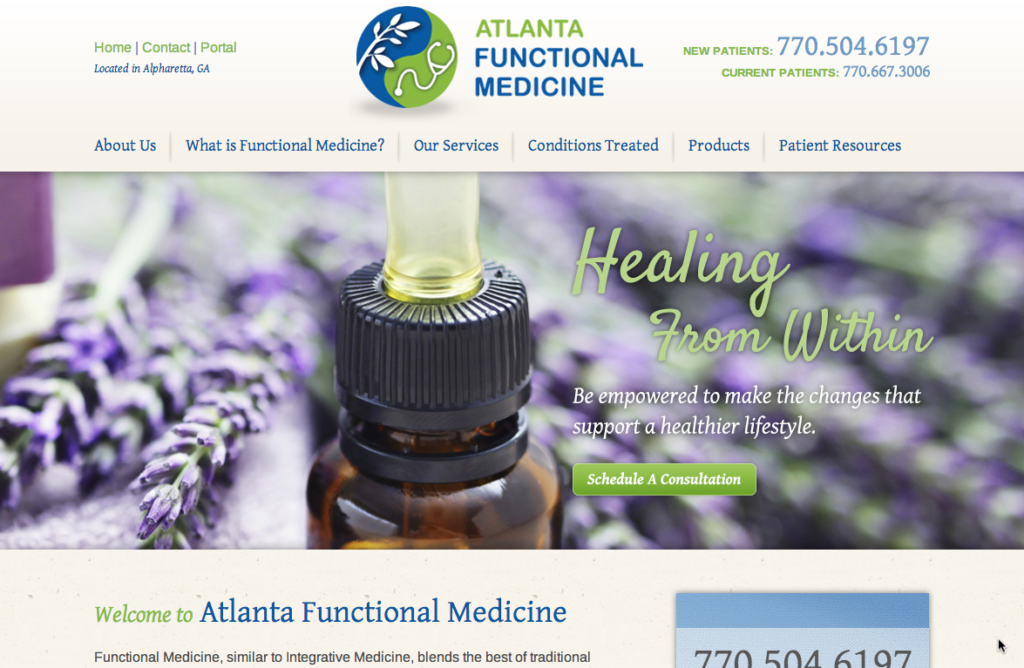
Dr. Elizabeth Board is a phenomenal individual and the first (and only) Medical Doctor in Georgia to be board certified by the Institute for Functional Medicine. Dr. Board came to Ads Next as she was starting a new practice. She had this to say about her experience:

“My experience with Ads Next has been truly unique because their program has literally created relationships for my practice. I say relationships because over the last 15 months, the right patients have been coming into my office. Without Ads Next, the growth of my practice would not be as rapid. Their program has gone far beyond what I had come to expect from a website or SEO company and I can honestly say that Ads Next has been the best marketing decision I have ever made. ” Elizabeth Board, MD, DABA, IFMCP
Find Out How Ads Next Can Help You
If you’d like to find out how the Ads Next Performance Program can help your medical practice, give us a call at 410.960.5217 or email Bill Mulcahy for a free demo bmulcahy@adsnextwebsites.com
Tags: ads next baltimore, Medical Websites
Posted in: Local Internet Advertising, Medical Websites, Websites and Marketing
Wednesday, April 16th, 2014
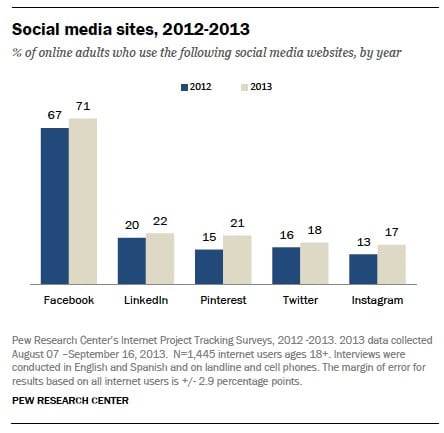 Think about the ways in which social media has changed and shaped the way you get your news and information. There are 1.3 billion Facebook users. According to Pew Research, 71% of American adults use Facebook. Plus there’s all those other social networking sites.
Social media has changed the way people interact with one another. It’s also influencing Google and other search engines.
Getting started with social media can be intimidating, though – especially for our clients in the dental and medical fields. Sometimes the best way to start is by sitting on the side of the pool and getting your feet wet.
We suggest you start by following Ads Next on your favorite social media platform. We use social media to share news and information about what’s going on in the marketing world as well as what’s happening in our own company. We like to share stories about what other doctors and dentists are doing to thrive in a competitive market and show off our latest design work.
When you’re ready, give us a call or contact us online to find out about our Social Media Marketing packages and how they can help drive more business for your practice.
Ads Next on Facebook
What you’ll get: News & Updates on things happening at Ads Next and in the medical/dental marketing industry. Occasionally, we slip in pictures of us having fun. Follow Ads Next on Facebook
Ads Next on Twitter
What you’ll get: Quick updates about things happening at Ads Next and in our industry. Follow @adsnext on Twitter
Ads Next on Google+
What you’ll get: In addition to our news, you’ll see videos, client review and more. Follow Ads Next on Google+
Ads Next on Linked In
What you’ll get: On Linked In, you can connect with our team members as well as our company. Plus, we’re building a special community for Ads Next dentists on Linked In. Follow Ads Next on Linked In and join our Ads Next Dentists Group
Need Help Marketing Your Dental Practice?
Contact Ads Next for a Free Dental Marketing Analysis
Let us show you how you can reach your full potential with a high performance dental website and dental marketing strategy. Contact us today: 866-623-5325 or by email.
Tags: ads next baltimore, Facebook, Google+, LinkedIn, Social Media Marketing for Dentists, Twitter
Posted in: Dental Marketing, Dental Websites, Facebook, Social Media Marketing
Wednesday, April 9th, 2014
You’ve heard it before: content is king. But, what does that mean? Does Google understand the meaning of the words on your website?
Yep. And with the Knowledge Graph (launched in May 2012), it’s getting better every day.
Information Engine to Knowledge Engine
Google is moving to change from being an information engine to being a knowledge engine. There are more than 60 trillion web pages on the internet. You read it right, trillion with at T.
Here’s how it works: Google crawls the web, sorts information and indexes it. When someone does a search, Google’s algorithm jumps into action. This is like a complex equation that uses many variables to generate a specific set of results.
Those variables used to generate your search results depend on many, many, many things like your physical location, what type of device you’re searching on, your search history, whether or not you’re logged into gmail or google+, etc.
Google uses more than 200 factors to rank results and try to deliver people with the best possible options. What are these 200 factors, you ask? Finding out is like trying to get the recipe for the secret sauce, but we do know a few things they’re looking for:
- Site & Page Quality
Quality comes in many forms. It is important for your website design to be current and easy to use. Make sure you pay attention to best practices when it comes to layout, site speed and mobile usage.
Page quality means having good content. Articles on your website should be at least 300 to 500 words in length and strike the right balance for mentioning your target keywords (just enough, but not too much). Grammar and spelling matter – so take the time to craft copy that is easy to read.
- Engagement
Engagement is a factor that goes into determining the quality of an individual web page or website. How long a user stays on a page, whether or not they share it on social media, if they come back to your website more than once. We’re now seeing search results influenced by Google+ – if a friend has reviewed a place or posted about a business, you may see that information filter into your search results.
- Media Rich Sites
Photos and video are important elements of a quality web page or website. Make sure the photos are high resolution. Google can’t read photos, so make sure you have an alt attribute, which is the text alternative that tells the search engine what is in the photo.
- Freshness
Google likes to see websites that are fresh and routinely updated as opposed to being static. Visitors want current and relevant information, so be sure to update your website routinely.
- Safeness of a Website
Search engines spend a lot of time combating spam. Make sure your website is checked regularly to be sure it hasn’t been compromised. If you do find a problem, fix it quickly and report it to Google so they can restore your status.
- Context
We touched on this earlier when we talked about how Google gives you results based on things like where you are, what kind of device you’re searching on and what kinds of searches you’ve done in the past.
Another area where context comes into play is with the content. Think about the multiple meanings of some common dental keywords like “crown”, “veneer” and “implant”. Be sure to give these keywords the proper context by including other words like “dental”, “teeth”, “dentist”, “cosmetic dentistry”, etc.
Making The Knowledge Graph Work For You
The Knowledge Graph is constantly evolving. When it first launched, the Knowledge Graph seemed to focus mostly on facts about famous people, important events and places. Last year, Google started to roll out Google Carousel, which showcases up to 20 results in a picture format. This feature is mostly impacting the travel, hospitality, restaurant and entertainment industries, but who knows what the future holds for other businesses.
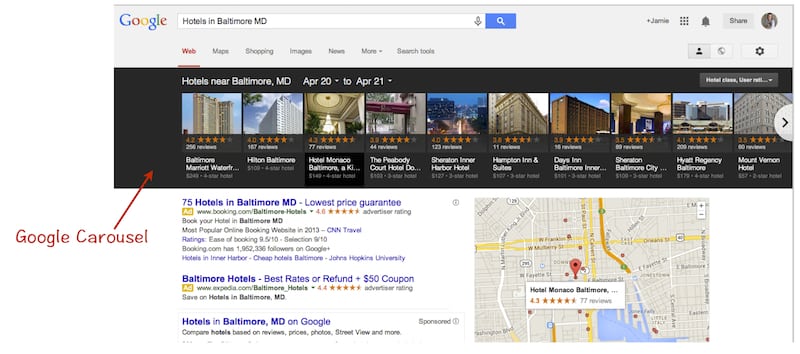
It’s important for all businesses marketing on the web to try and stay ahead of the curve. You can do this for your business by:
- Making sure you’re signed up for Google Places for Business. This tells Google your basic business information and is integrated with Google maps.
- Verify your Local Google+ Page, which pulls all of the information from your Google Places for Business listing and gives you the ability to build and engage with a social network.
- Upload high resolution images of your business to your Google profile and prioritize them.
- Encourage your customers to leave positive reviews on your Google profile. Make sure that the reviews are well written and don’t come across as spam. Encouraging reviews should be an ongoing marketing effort, Google likes to see frequency and freshness.
By: Kelly McGee, Director of Internet Marketing for Ads Next
Need Help Marketing Your Dental Practice?
Contact Ads Next for a Free Dental Marketing Analysis
Let us show you how you can reach your full potential with a high performance dental website and dental marketing strategy. Contact us today: 866-623-5325 or by email.
Tags: ads next baltimore, Dental Marketing, google knowledge graph, internet marketing strategies, SEO
Posted in: Dental Marketing, Dental Website, Dental Websites, Local Internet Advertising, search engine rankings, SEO, Websites and Marketing
Tuesday, April 8th, 2014
One of the things that sets Ads Next apart from other internet marketing companies is the hands-on approach we take and time we spend building relationships with our clients. We are fortunate to have a relationship with Dr. John Cranham, the clinical director of the Dawson Academy. Ads Next designed the website for Dr. Cranham’s private practice and manages a dental marketing campaign and social media strategy.
Dr. Cranham took the time to share his experience:

“I’ve had the pleasure of working with Ads Next for more than 4 years. During that time, they helped me develop a core marketing strategy and multiple initiatives to increase new patients and raise brand awareness. Because of Ads Next, I’ve seen higher conversion rates and an increase in the number of patients who value the services my practice provides.” John Cranham, DDS www.CranhamSmiles.com
Find Out How Ads Next Can Help You
If you’d like to find out how the Ads Next Performance Program can help your dental practice, give us a call at 410.960.5217 or email Bill Mulcahy for a free demo bmulcahy@adsnextwebsites.com
Tags: ads next baltimore, dental marketing program, dental website, marketing strategies for dentists
Posted in: Dental Marketing, Dental Website, Dental Websites, Local Internet Advertising, Websites and Marketing
Wednesday, February 19th, 2014
More than 30% of internet users say they mostly use their phone to browse the internet. As this population increases, Google and other search engines are placing more and more emphasis on user experience across a variety of platforms. A responsive website isn’t just a “cool technology”, it’s a marketing tool to ensure that you secure and maintain top rankings in the search engines. Tweet This
What is a Responsive Website?
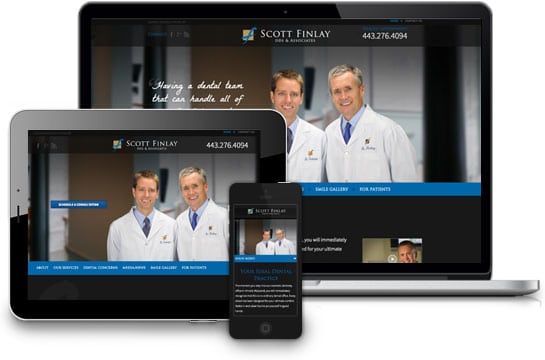 In simple terms, a responsive website seamlessly adapts to multiple screen sizes, ensuring your website visitors get the full experience regardless of the device they’re browsing on.
Isn’t a separate mobile website better?
The old way of thinking was that mobile websites should be a stripped down version of your website. The assumption was that because a user was on a mobile phone, they were probably on the go and just needed quick information.
It turns out, that’s not the case and anyone who’s had the experience of visiting the mobile version of a website on their phone knows what a frustrating experience it is to only have access to a fraction of the company’s full website.
Responsive Design = Best Practice
Today, website design companies and marketers are taking note of the fact that Google has gone so far as to say responsive web design is an industry best practice.
A mobile website is completely separate from your desk top website. It has a separate URL, separate HTML and separate content. This creates an issue for search engines who have to crawl and index two sites separately.
By contrast, a responsive website is one website, with the same content. This means you don’t have to worry about diluting your authority in the search engines or being penalized for duplicate content. It also means you don’t have to worry about making separate updates to your websites, which is a common challenge for businesses with a separate mobile website.
If SEO is an important part of your marketing strategy, a responsive website should be a priority. Tweet This
But our clients aren’t using smart phones
 Responsive websites aren’t just about smartphones and tablets. A responsive website adjusts regardless of the screen size, that means people who view your website on laptop monitors or large desktop screens will have a great experience tailored for their specific device.
And if you think that your patients aren’t using mobile technology, think again. The Pew Research Internet Project released an update to its Mobile Technology Fact Sheet in December 2013 finding:
- 55% of American adults have a smartphone
- 42% of American adults own a tablet computer
- Smartphone ownership has increased 20% in the past 3 years
- Tablet ownership has increased by almost 40% in the past 3 years
- And desktop or laptop ownership has remained relatively flat since 2006
Mobile Technology Is Outpacing PCs
Consumers are adapting rapidly to new technologies and it is anticipated that tablet sales will outpace PC sales by end of year 2015, according to research by the International Data Corporation (IDC).
How Do I Get a Responsive Website?
Now that you’re sufficiently motivated, you’re wondering how do I get a responsive website. We wish it were as easy as clicking a button, but unfortunately, it isn’t.
Converting a “standard” website to a responsive website is generally not an easy task, nor is it the best approach.
With any type of website design, but especially responsive design, considerable architectural planning needs to go towards determining the market and marketing goals, outlining user profiles, creating a content strategy and hierarchy of information.
You want to meet with a website designer and marketing team who can first help map out your business objectives and deliver a strategy to meet those goals. Then, you start to think about the design, which is not just how the website will look, but how it will function across a wide range of technology devices.
Need a Partner? Ads Next Can Help
Ads Next offers an “all-in-one” solution for businesses called the Performance Program. This includes a responsive website along with comprehensive marketing strategy and performance coaching. If you’re ready to take the next step in your online marketing strategy with a responsive website, give us a call for a free analysis. Call 866-623-5325 or by email.
Tags: conversion driven websites, internet marketing strategies, Local Business Websites, Responsive Website Designs, revenue focused marketing, Website Design Ideas
Posted in: Dental Marketing, Local Internet Advertising, Mobile Marketing, Mobile Website, Responsive Website Design, Social Media Marketing, Websites and Marketing
Friday, February 14th, 2014
In honor of Valentines Day, we wanted to take a moment and share some website love. Enjoy the showcase of our four most recently launched projects.
Kitchen Magic Refacers, Inc.
 We helped Kitchen Magic “reface” their website just in time for the Spring home show season.
Why We Love The New Site
- Great new galleries to showcase Before & After Photos as well as Cabinet Door Styles
- News & Events and Social Media are front and center to keep customers connected
- Fully responsive website adapts to various size screens including tablets and smart phones
Visit Kitchen Magic Refacers Website: KitchenMagic.net
New Bern Smiles
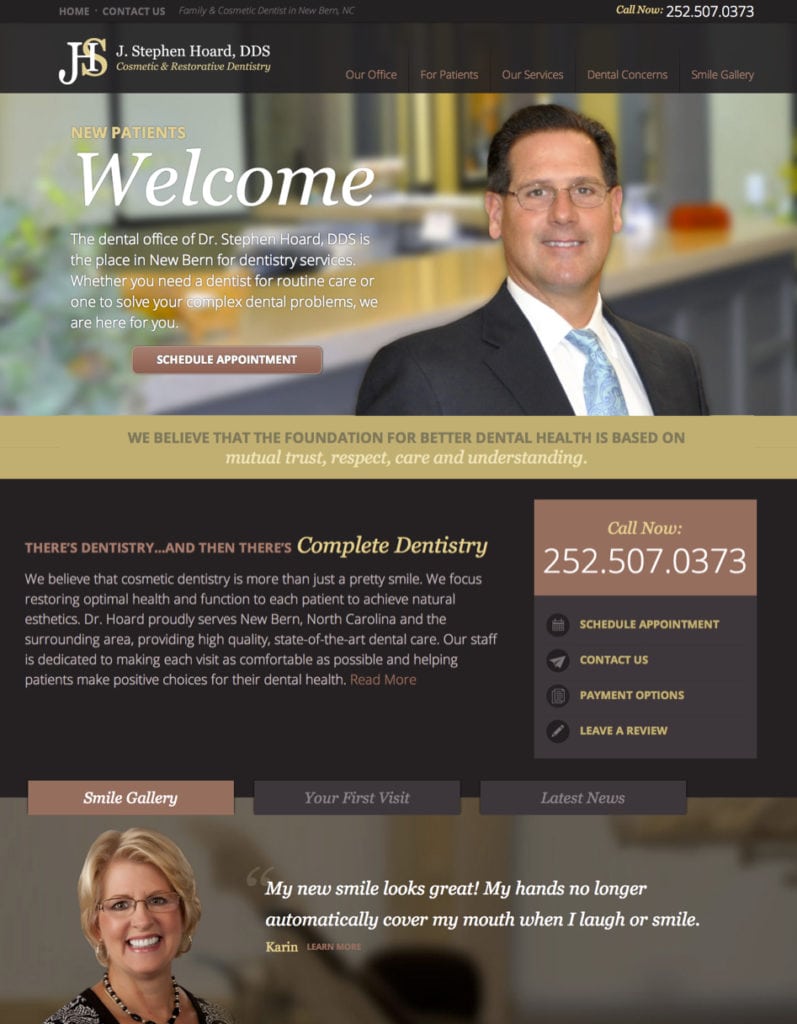 Dr. Stephen Hoard is an Associate Faculty Member of the Dawson Academy and long-time Ads Next client. We recently revamped Dr. Hoard’s website, updating the look and converting it to a responsive design.
Why We Love The New Site
The new site has a very clean, modern design and is easy to navigate with a rich, soothing color palette that draws you in.
But what we love most is the smile gallery! The patient portraits, combined with the before and after and testimonial really tell a story.
Visit Dr. Hoard’s Website: NewBernSmiles.com
Advanced Chimney Sweeps
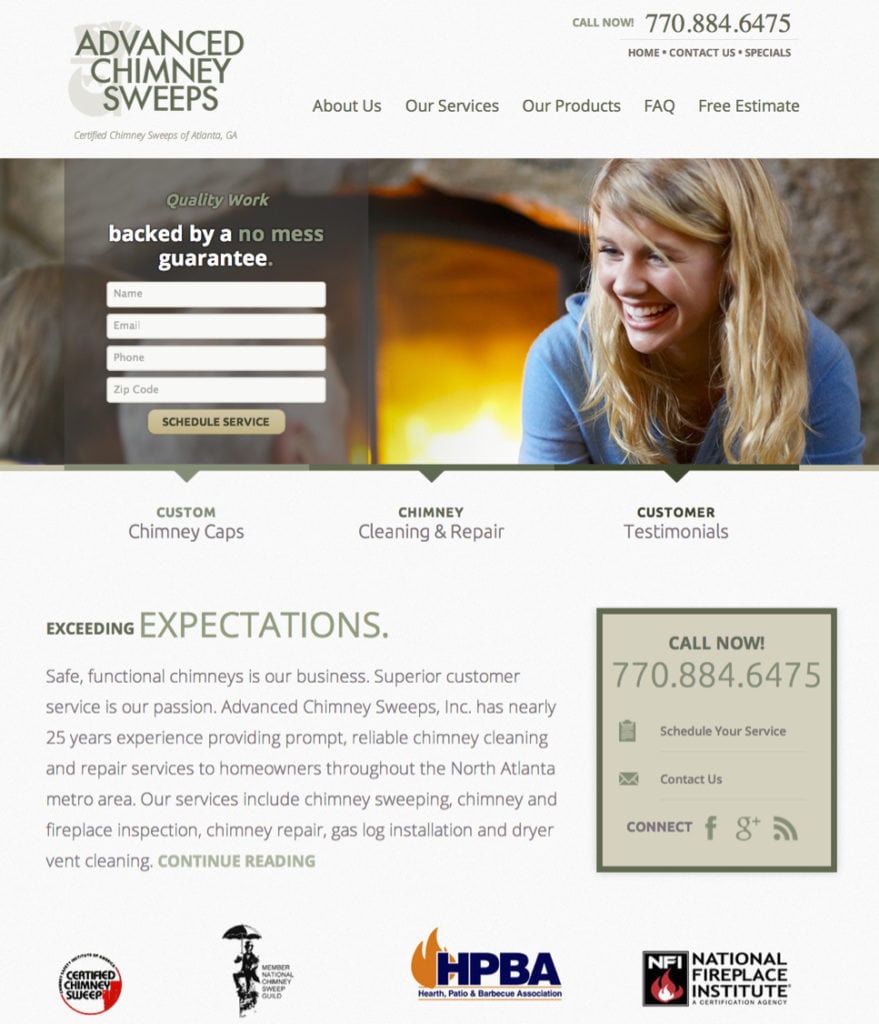 Advanced Chimney Sweeps of Atlanta has been with Ads Next since 2010. Delivering a great experience to visitors on smart phones was a top priority of this redesign project.
Why We Love the New Site
It looks great on smart phones. The new design is warm and inviting, but still very modern.
Plus, it’s designed to capture and convert visitors into leads with easy to find phone number, contact information and free estimate form.
A new and improved gallery section shows off Advanced Chimney’s selection of custom chimney caps and gas fireplace inserts.
Visit Advanced Chimney Sweeps Website: AdvancedChimneysInc.com
Ruby Salon
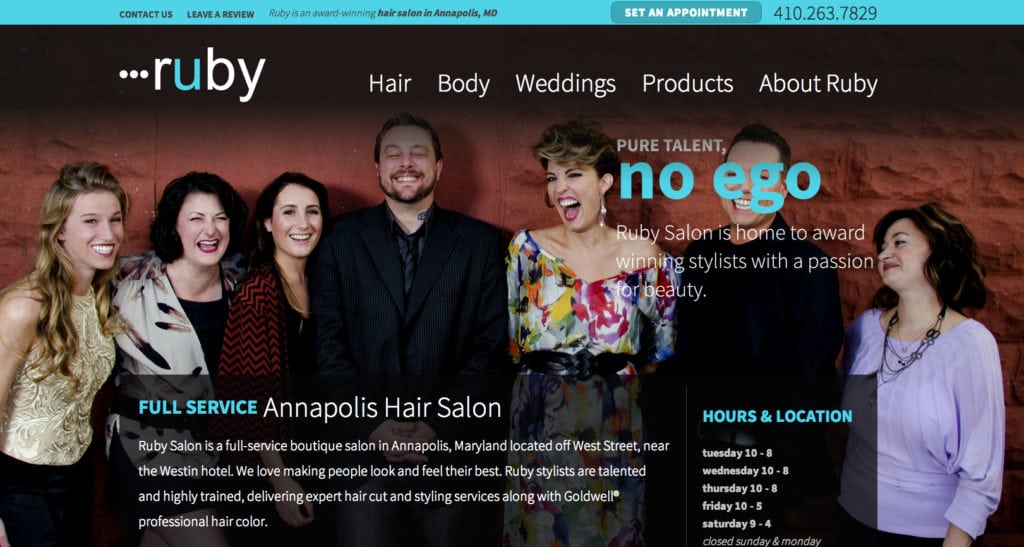 What a fun project to work on! The most important thing with this project was to capture the style and personality of the salon and draw customers in.
Why We Love the New Site
The photos are what really made this website redesign project pop. The salon had an excellent selection of professional photography for us to work with and we supplemented where needed with stock photography.
Visit Ruby Salon’s Website: RubySalon.net
By: Kevin Gallagher, Internet Marketing Consultant
Tags: Ads Next Websites, Local Business Websites, Responsive Website Designs, Website Design Ideas, Website Design Inspiration
Posted in: Local Internet Advertising, Responsive Website Design, Websites and Marketing
Wednesday, February 5th, 2014
 Do you feel like your front desk staff struggles with answering the phone? Are they not meeting your expectations? Are you looking for a way to increase revenue without increasing your costs? It may be time to adjust your approach. By converting a higher percentage of the calls coming into your practice, you can literally make more out of what you already have.
If you are looking for a good place to start, consider these seven steps to help you convert new patient calls.
Empower
It’s easy to overlook how important the person who answers your office phone is. More importantly, that person may have no idea how important they are. If she’s not effective, the practice cannot reach its full potential. Spend the time with this person or group of people to help them understand how their performance directly impacts the practice. Explain to her what you expect, how you want the practice represented, and set realistic goals for her to live up to. Reiterate these expectations frequently.
Baseline
It is impossible to track the progress without establishing a baseline. This is a simple starting point to help you outline goals and expectations. One baseline assessment may be to tabulate the number of incoming new patients your practice receives. Compare the number answered by your staff to the number that go to your voicemail or answering service. Another starting point to establish is how the phone is being answered. Consider the number of rings, the amount of time people are placed on hold, the greeting and answers for commonly asked questions. Evaluate your baseline and use it as a spring board for how you want things done moving forward.
Plan
At Ads Next, we work with dozens of dentists around the United States and we’ve found after monitoring hundreds of new patient calls, a majority will fall into 5 or 6 categories. They will mainly have to do with basic questions about the practice, dental services, insurance questions or financing concerns. We find that within the same office, even by the same receptionist, the same questions are answered differently each time. We recommend to our dentists that they create a plan the office staff can follow each time they answer the phone. From the greeting to answers for commonly asked questions, having a script or planned response will allow you to better measure what works and what doesn’t work.
Train
There are many options for phone skills training available in the market today. The most traditional are; personal consulting and coaching, online training, simple online practice modules, and numerous books and articles. Whether you choose to invest in one of these methods or not, you should make an investment of your time. Listen to the calls that come in to your practice. Are they doing a good job? Are they missing opportunities? Are they representing your practice in the way you want to be represented? Schedule time each month to review your findings with your staff, re-establish your expectations, and give them feed back in regards to what they did well and what they need improvement on.
Review
There are many things to review each month with your staff to insure that they did the best job they could converting your practices new patient leads. By listening to the calls, you can understand how many opportunities were missed. You can also identify other issues such as missed calls, unacceptable hold time, or trouble handing specific types of questions like “is your practice in my dental insurance network”. You can also make sure that incoming leads are being followed up on. A standard review process each month will go a long way to insuring that you are making the most out of the calls and forms that come into your practice.
Measure
Now that you have established a baseline, created a call plan, provided training and reviewed the incoming calls, and leads, it is important to measure the result from one month to the next. You want to see continued progress, but you definitely don’t want to see the numbers drop off. By measuring results you can better control the outcome and continue to find areas that have need for improvement.
Reward
If you are going to expect more from your employees, they are naturally going ask, what’s in it for me? Assuming that you think highly of the person working for you and understanding that good people are not always easy to find, telling them that they get to keep their job likely isn’t realistic and not very motivating.
The best way to get buy-in would be to establish a method of reward. Many offices use a monetary monthly, quarterly or annual bonus as a reward based on revenue or number of new patients. If you like the idea of a monetary reward, I would suggest that you choose the monthly option. It establishes a commitment each and every month. You can’t slack one month and then do a great job in the others and make the same money. You also avoid a situation where the goal is reached early in the year or you find later in the year that the numbers you set were not realistic and need to be altered. The monthly option gives you the flexibility to make adjustments as needed.
Monetary rewards are not the only option. Many offices establish other rewards such as extra vacation days, special recognition, gifts or even fully paid trips. The type of reward is not as important as the idea of giving them some kind of stake in the success of the practice.
By Bill Mulcahy, Vice President of Ads Next
Need Help Marketing Your Dental Practice?
Contact Ads Next for a Free Dental Marketing Analysis
Let us show you how you can reach your full potential with a high performance dental website and dental marketing strategy. Contact us today: 866-623-5325 or by email.
Tags: ads next, Dental Marketing, Dental Practice Marketing, Lead Conversion Coaching, Phone Call Training
Posted in: Dental Marketing, ROI Tracking, Websites and Marketing
Friday, January 31st, 2014
 When you discover you received a negative online review, the hardest thing is knowing what to do. You read the review once, then twice and pretty soon you are so upset that you feel the need to passionately defend yourself. Unfortunately, this is the worst thing you can do in the online world and I have seen numerous cases where emotion made a bad situation worse.
So, what is the right thing to do? There’s no single answer, but here are 5 things you can do that won’t make an unfortunate situation worse.
1. Don’t get emotional
You take pride in the work you do and you try to do the best job possible. When someone writes a negative review it hurts. As hard at it is to take criticism in stride, the best advice is to not get emotional. The worst thing you can do is participate in an online battle of words over this review. These exchanges come off as unprofessional and can make you seem childish and petty.
2. Address the Review Directly and Professionally
Although an emotional response is a bad idea, responding directly and professionally can help. A well thought response communicates to other would-be customers that you care about making your customers happy.
The best responses are simple responses. An example would be: “I am sorry to hear about your bad experience with us, but we are committed to exceeding our customer’s expectations. Please feel free to call me directly to discuss and I will do my best to resolve the situation.”
3. If given the opportunity, genuinely try to resolve the situation
Sometimes the reviewer will take you up on your resolution offer and give you a call. If they do, take them seriously. Talk through their issues and see if you can come up with a sensible resolution. If the situation is resolved, the same person that criticized you may end up singing your praise.
4. See Negative Reviews as Opportunity
Just because you don’t like to hear negative feedback doesn’t mean the feedback is wrong. The most savvy business owners use negative reviews as learning opportunities. Take the time to understand the feedback, do a self-assessment, and then make any necessary changes to improve your business.
5. Get Some Positive Reviews
Yes, one bad review probably cancels out 5 good reviews. But, one negative review with no positive reviews, hurts even worse. If you have multiple people signing your praise, potential customers are more likely to look at a negative review as an isolated incident. So, make sure your business has a strategy to encourage positive online reviews.
Research shows that nearly one-quarter of Internet users leave online reviews about products and services they use. If you’ve given someone a good experience, chances are they’ll want to share it with others. Create and maintain places where people can get to easily and leave a review. The most common places are Yelp, Google+ and Facebook.
By Bill Mulcahy, Vice President of Ads Next
Need Help Marketing Your Dental Practice?
Contact Ads Next for a Free Dental Marketing Analysis
Let us show you how you can reach your full potential with a high performance dental website and dental marketing strategy. Contact us today: 866-623-5325 or by email.
Tags: baltimore, Dental Marketing, How to Deal with Bad Reviews, Negative Online Reviews, Reputation Management
Posted in: Dental Marketing, search engine rankings, Social Media Marketing, Websites and Marketing
Monday, January 27th, 2014
For decades, most doctors and dentists have gotten by without investing much money in advertising or marketing their practices. In fact, most doctors avoided advertising so they wouldn’t be seen as “ desperate” or “hurting for patients”.
 Instead, most medical professionals relied on “word of mouth” advertising, this being the notion that your existing patients would refer their friends and family to your practice and that would be your source of new patients. While that strategy certainly was effective, it has become less and less so in the last decade.
Today, most doctors and dentists have a website, but the concept of marketing is still new. There are a few doctors who question whether or not they need a website and many who don’t think it’s an important part of their business.
Here are seven reasons why any business, but especially a medical practice, should invest in a website and online marketing strategy:
Your Website is Open 24/7
Your website works tirelessly. No lunch breaks, vacations, holidays or sick days. That means people can access your website anytime they want to learn about you and your practice. Provide useful information about your services, staff, facilities including answers to questions about insurance, treatment costs, etc.
Make it easy for people to contact you. A short form is a great option. If you’re listing a phone number, make sure there is a way for patients to leave voicemail. Or, better yet, consider an answering service that will give patients a live representative who can take a message and pass it to you for the next business day.
You Can Measure Your ROI
There are very few forms of advertising that give you the ability to track your efforts and measure your return on investment. Services like Google Analytics provide detailed statistics about traffic coming to your website and what happens once users are there.
At Ads Next, we use this data along with other analytics to tabulate the number of leads (potential patients) contacting your office and compare them to the actual number of new patients making appointments.
Yes, Everyone Else Is Doing It
Rest assured, the internet is not a trend. Online marketing will continue to be important for businesses for the unseeable future. And while things will change and evolve as they always do, that’s no reason to stand on the sidelines.
Your competition is already marketing their practices online. This puts you at a disadvantage. Not having a website is taking yourself out of the game and seriously limiting your the visibility of your business.
Manage Your Online Reputation
Nothing is worse than when a dentist or doctor comes to us because there are negative reviews of them online. If you don’t have a website, you have no alternative for prospective patients to learn about you other than the negative review. A website won’t solve a reputation management crisis, but it will mitigate the effects by presenting your brand the way you want it to be represented, instead of by one or two unhappy patients.
Internet Marketing is Cheap
Let’s start by saying: you get what you pay for. But, compared to alternative forms of advertising, internet marketing is very affordable. Magazine ads can cost thousands of dollars per issue and you have limited ability to track their effectiveness.
When you market your practice online, you can expect the largest single investment to go towards the website itself. Ongoing marketing such as Search Engine Optimization (SEO), Pay Per Click (PPC) and Social Media can be tailored to fit practically any set of goals and/or budget.
Like a good financial advisor, a reputable marketing company will help you diversify your marketing strategy, identify new opportunities, highlight the areas where you’ve had success and determine your return on investment.
If You’re Not Online, You Can’t Be Found
There are more than 5 billion google searches happening each day. A 2012 report from the Pew Internet & American Life Project stated that 91% of search engine users say they always or most of the time find the information they are seeking when they use search engines. If you don’t have a website, it will be difficult for internet users to find you and learn about your practice.
Increase Trust in Your Brand
People have constant access to the internet and they are far more likely to go online and research a product, service or organization before they ever step foot in a brick-and-mortar business. Even people who’ve gotten a recommendation from a friend or family member are more likely to “check it out” online for confirmation before they finalize their decision.
Your website should be a virtual extension of your office. Be consistent with your brand imagery and messaging use actual photos of your office and staff. You only get one shot at making a first impression, so be sure your website represents you in the best way possible.
Bottom line, do you need a website? Absolutely
Invest in a professional-looking website and hire a company that can develop a long term marketing strategy. And remember, you get out of it what you put into it. If you take internet marketing seriously, you’re more likely to see the return you’re looking for.
by Jamie Tiralla, Content Marketing Strategist for Ads Next
Tags: ads next, baltimore, Dental Marketing, dental websites, internet marketing strategies, strategic dental marketing
Posted in: Dental Marketing, Dental Website, Local Internet Advertising, search engine rankings, SEO, Websites and Marketing
Thursday, January 23rd, 2014
Having worked in the website and online marketing fields for more than a decade, I have had the experience of seeing different philosophies and approaches to websites and internet marketing.
As the founder and President of Ads Next, I combined my experience with the talents of my team to build the best “solution” for our clients. We believe that a successful marketing strategy must include a great looking website.
The A La Carte Approach
Most businesses will take an a la carte approach to marketing themselves. This means hiring separate companies to build your website, handle your search engine marketing, run a social media campaign, etc. While it seems like you’ll have more control over each step of the process, most businesses end up missing out on their full marketing potential.
Logically, the first thing a business owner thinks about is creating a new website. In our industry, “Custom Websites” generate a lot of attention and there is a belief that custom is better. There certainly are benefits to a custom website, primarily being that they are unique to your brand and you can have precise control over the look and features of the website. One of the biggest drawbacks is the cost, typically ranging between $7,000 and $15,000. But more than that, most website design firms don’t specialize in marketing and fail to align the website design with the business objectives.
Once the custom website is built and published to the internet, the design agency’s job is done and you go your separate ways. Reality usually steps in a few months later as you realize your new customer stream has leveled off or dipped to what you had before the new website. This is the point where most business owners realize they need a marketing strategy. For most companies, this means hiring separate firms for paid advertising, offline marketing, search engine optimization, social media, etc. Such a fragmented approach quickly becomes challenging to manage and frustrating as you try to determine which marketing efforts are generating the best results.
The Ads Next Approach
Ads Next works with businesses all over North America and what every one of them needs is a way to attract new customers or patients and increase revenue. They also want to be able to track and measure their results. This led us to create our unique Performance Program for internet marketing. We have integrated all of the essential parts: website and marketing to focus on the results: new customer acquisition. Our model has proven to generate a 10X return on investment or 10 new patients a month for most of our clients.
What’s Missing From Your Marketing Strategy
Our base marketing program is robust with potential to add on additional services depending on your business goals. The most important thing we recommend to clients, whether they choose Ads Next or not, is to make sure that your marketing agency offers an all-in-one approach to simplify your marketing efforts, maximize your potential and help you see where you’re being most effective.
Ads Next rolls everything into one program including:
- High-quality, responsive website unique to your brand
- Optional photography and video services
- Personalized content that is specific to your business and target market
- Focus on Search Engine Optimization, Paid Advertising and Social Media
- Tracked and recorded phone calls
- Reporting dashboard
- Marketing coach and review meetings
No matter how great your website looks, at the end of the day, it really boils down to whether or not you’re getting the results you want and need to thrive. Before you hire a marketing firm, reflect on your business objectives and then hire a company who can help you meet them.
By Brian Burns President of Ads Next
Need Help Marketing Your Dental Practice?
Contact Ads Next for a Free Dental Marketing Analysis
Let us show you how you can reach your full potential with a high performance dental website and dental marketing strategy. Contact us today: 866-623-5325 or by email.
Tags: ads next, baltimore, conversion driven websites, internet marketing strategies, online marketing, website roi
Posted in: Dental Marketing, Dental Website, Dental Websites, Local Internet Advertising, Search Advertising, Websites and Marketing
Friday, January 17th, 2014
 Promoting a dental practice in a highly competitive market can seem like you are fighting off the end of the world but follow these tips and you wont need to feel like you are facing a Zombie Apocalypse.
1. Don’t throw money at it!
Yes, promoting a dental practice in a competitive market takes money but it is very important that you set an expectation. Either set a budget and work to determine realistic goals based on that budget or establish your goal and work out an estimate of the budget necessary to achieve them. If you don’t approach your marketing efforts this way, your pockets will feel a lot emptier.
2. Know your competition
Online competition can be very different from local competition. The dentist you know that is one street over may not be who you are competing with online. Too often, dentists don’t spend any time or effort understanding who their competition is and what they are doing. Do an analysis, identify strengths and weaknesses and determine who is keeping you from achieving your goals.
3. Play Your Game
The downside to knowing your competition is that dentists tend to get too caught up in what the other guy is doing. Your program should be determined your goals and your budget. By focusing too much on the other guy you can lose site of your plan.
4. Walk Before You Run
Websites, Branding, Blogs, Facebook, Twitter, Instagram, Google Adwords, SEO the list goes on and on. If you read articles about internet marketing, you’ll realize that in their own way, all of these things can have a positive impact on your practice…but beware! If you try to do too much before you have established a strong foundation, the marketing process will become overwhelming. You will end up dedicating too many hours, too much money and effort to do it all.
5. Make the Most of What You Have
I can’t tell you how often I talk with dentists who come to me wanting more. More traffic, better rankings and more leads. All of this is extremely important but the first question I ask is how are you doing converting the leads that are coming in now? You need to make sure that you are making the most of your leads whether it is 2 or 102. If the phone rings, make sure it is answered. If it is answered, make sure your staff handles the call correctly. If someone requests an appointment, make sure you follow up and most importantly always ask for the appointment.
Consider these tips the next time you analyze your marketing efforts. They just may save you time and money.
By Bill Mulcahy, Vice President of Ads Next
Need Help Marketing Your Dental Practice?
Contact Ads Next for a Free Dental Marketing Analysis
Let us show you how you can reach your full potential with a high performance dental website and dental marketing strategy. Contact us today: 866-623-5325 or by email.
Tags: Dental Marketing, dental marketing programs, Dental Practice Marketing, strategic dental marketing
Posted in: Dental Marketing, Dental Website, Local Internet Advertising, Websites and Marketing
Thursday, January 16th, 2014
 Most successful dental practices have been able to thrive for years with referral-based new patients. Unfortunately, this “word of mouth” marketing approach is no long the most effective way to generate new patients.
Search engines are the new yellow pages for dentists, the first place people go when they’re looking for a local dentist. A quick Google search for a dentist in a given city will yield thousands of results, all claiming to be the best and offer the best services.
With such fierce online competition, dentists often come to us asking “What can I do to break through the noise?”
In no way a comprehensive list, here are 10 ways you can market your practice to new patients:
1. Have a Game Plan
In the industry, we call this a strategy. More specifically, a content strategy. This means taking the time to spell out your business objectives and target audience.
When Ads Next meets with a new client, the first step we take is to ask a series of questions so that we can formulate a content strategy.
Where are you located? How far are your patients willing to drive to come to your office? Tell us about your current patient base? Is there a certain type of patient that you’d like to increase?
The goal in this exercise is to come away with messaging that will connect with your target audience and content that will get you found in the search engines.
2. Build a High Converting Website
Not all websites are created equal. There are dental websites that look great but aren’t user friendly or rank well in search engines. On the flip side, you have dental sites that dominate search results but look like something from the early days of the internet. Just because a website ranks well doesn’t mean it’s converting vistiors into leads or attracting the type of patients you want for your practice.
The goal is to shoot for something in between – a modern dental website design that matches the look and feel of your office, built to maximize user experience.
When you place emphasis on creating a good user experience, you’re making it easy for visitors to get the information they want and take action. For a dental practice, this action is usually to schedule an appointment. A prominent phone number, easy to use forms and accessible contact information are critical to converting dental website visitors into new patients.
3. Search Engine Optimization
SEO is a mysterious acronym for most businesses outside of the marketing industry. It is important that your marketing agency takes time to research your market, your geographic area and business objectives to identify which searches are going to generate the most value for your practice.
The information Ads Next collects during our initial kick off call helps us shape and define an SEO strategy that will position a website prominently and engage with the end user.
4. Google+ Optimization
There are many search engines out there, but Google is still the most popular. Google continuously adjustments its algorithms to deliver searchers with more relevant, local results. Your Google listing is very important to these results.
Optimize your Google listing by making sure it is accurate and complete. Encourage patients to post reviews of your practice on Google+. Businesses with current reviews (within the last two weeks) have the strongest advantage in search results.
5. Pay-Per-Click Advertising
Known as PPC, paid search engine advertising puts you front and center before people who are actively searching for your services.
PPC is especially useful for dental practices who are new to internet marketing or trying to boost their online performance, as well as dentists who are trying increase leads for a specific service or treatment, like dental implants or teeth whitening.
6. Blog Marketing
It seems like everyone has a blog these days. But blog marketing isn’t just a trend. It is a valuable way to market your practice and supply your website with fresh content.
Use your dental practice blog to answer questions potential patients have about your services. A blog is also a platform where you can update current patients about practice events, news or awards. Publishing interesting, useful content on your blog can increase user engagement with your website and translate to new business for your practice.
7. Social Media
Social media marketing is intimidating for many dentists. How to get started, what to share…but avoiding social media isn’t the answer either.
 Facebook, Twitter and YouTube can help you broadcast your message outside your website. Forming social connections with friends, patients and colleagues widens your audience and puts you in front of hundreds or thousands of new opportunities.
Additionally, social media profiles are ranked highly in search engine results pages (SERPs). Make sure you leverage this potential by signing up for social media accounts, fully completing your profile and keeping your accounts updated with regular posts and activity.
8. Reputation Management
One bad review can have a devastating impact on a dental practice. It is important to monitor online reviews of your practice and take immediate action when negative reviews appear.
An easy way to do this is to do a Google search for the dentist’s name or practice name and see what comes up. If you find a negative review, it’s a good idea to respond.
Remember to be polite and non-defensive in your response. Leave your response open ended, asking for the opportunity to “make things right” – you might not be able to change the reviewers mind, but you can show potential patients that you’re willing to do what you can.
9. Analytics and Results
Part of an effective marketing strategy includes taking a look at your performance and comparing it to your goals. Chart fluctuations in your performance and identify trends by comparing recent data to previous months or years. Simple adjustments to your strategy can often increase performance and help you surpass your goals.
10. Customer Service Analysis
One of the most important steps you can take in marketing your practice is to take a look at your customer service performance.
 The last link in the online marketing chain is usually the person in the office who handles the incoming leads, whether they are by phone or email. You can analyze your performance by comparing the number of leads that come in to the number of new patients in a given month. This “conversion ratio” can help you determine if you need to make adjustments to your customer service strategy.
If you give your staff the tools they need to handle incoming calls effectively, you will see an increase in the number of new patients. This means having a consistent script that your staff follows and rehearsed answers to common questions like dental insurance and requests for prices over the phone.
By Kelly McGee, Director of Internet Marketing
Need Help Marketing Your Dental Practice?
Contact Ads Next for a Free Dental Marketing Analysis
Let us show you how you can reach your full potential with a high performance dental website and dental marketing strategy. Contact us today: 866-623-5325 or by email.
Tags: Dental Marketing, dental marketing programs, Dental Practice Marketing, dental practice website company, internet marketing strategies, strategic dental marketing
Posted in: Dental Marketing, Search Advertising, Websites and Marketing
Monday, December 10th, 2012
The Internet has undeniably changed the face of healthcare and the way dentists market to their patients. As more and more people use the Internet to research dental conditions and locate a dentist in their area, a dental practice must be acutely aware of the unique challenges brought on by Internet marketing and develop effective strategies to convert web visitors into new patients.
If your website does nothing else, it should communicate who you are, what you do and most importantly, what sets you apart from other dentists. That message needs to carry through to your office, so that when a lead comes in, your staff is empowered to overcome common objections and book an appointment.
Ads Next works with dentists from across the country. We’ve found that the dental practices with the highest conversion rates, that is turning leads into new patients, share similar traits. One of those is to treat all incoming phone calls with purpose and provide simple answers to common objections.
The Characteristics of a High Converting Dental Practice
- Treat each incoming call with purpose
- Make a great first impression; be happy the patient called and make them feel welcome
- Articulate in a compelling way what separates their practice from others
- Have a predictable, simple new patient process
- Avoid the trap of collecting too much information or telling the patient too much before they come in
- Have easy answers to common objections like dental insurance or price
- Focus on setting an appointment rather than getting into specific answers about price
- When price information is provided, offer a value statement to help the patient make the association between price and value.
How Can You Convert More Leads Into Patients?
You can start by giving your front desk staff the tools to properly handle incoming calls. This means creating value statements and simple answers for common objections.
Ads Next is hosting a Free Webinar presented by leading dental practice consultant, Larry Guzzardo to share the best practices for overcoming common objections.
December 12, 2012
2pm
Sign Up Today
Webinar Highlights
- Best practices for handling incoming phone calls
- How to respond to leads from website forms and email
- Scripts and strategies to overcome common objections including: Do you accept my insurance? and Your fees are too high!
- Tips for developing a simple and effective new patient process
This information is presented by industry experts in dental practice management and dental internet marketing. Don’t miss this opportunity to maximize the marketing potential of your practice. Sign up for our webinar and find out how you can become one of the high converting dental practices.
by Bill Mulcahy, Vice President of Ads Next
Tags: ads next, baltimore, conversion driven websites, Dental Marketing, Dental Practice Marketing, dental practice website company, Leads Analysis, revenue focused marketing, roi
Posted in: Announcements, Dental Marketing, Dental Website, Dental Websites, Local Internet Advertising, Websites and Marketing
Monday, October 22nd, 2012
Recently, we had a kick off call with a new dentist. We asked him the same question we ask all new clients, “What makes you different from other dentists in your area?” He answered, “Me.”
He went on to explain that his staff has been together for many years. And that they are what attracts new patients to the office. They are friendly, respectful and they treat their patients like family.
His answer echoed the response of so many dentists we talk to. The personal connection is what sets each one apart. So that raises the question: How do create a website, something that is so distant and anonymous, that message makes a personal connection with visitors?
The answer is what sets AdsNext apart from other dental website companies. We take the time to get to know each dentist, to learn about their patients and the area they practice in, so that we can create dental websites that are engaging and leave a lasting impression.
How Do We Do It?
Practical Knowledge & Experience
We specialize in dental websites and internet marketing. Because we work with so many dentists from around the world, we understand what works and what doesn’t when it comes to a dentist website. We apply this knowledge into our designs to constantly create better, more engaging websites.
Research & Analysis
Each dentist is different. During our kick off call, we ask a series of questions to help us get to know the dentist, staff, location and target patient. We do additional research to learn about the area where the dentist is located. We analyze the competition and dentist’s current website to come up with a personalized content strategy.
Unique Website Design
Your website should serve as an online version of your dental office. We incorporate the logo, colors and other imagery you are using offline to tie in with your website design. Setting the mood on your website will help patients feel more comfortable when they visit your office, like they’ve “been there before.”
Real Photos
We can’t encourage dentists enough to use real photos on their websites. This might make the biggest impact with visitors. Photos of the dentist, staff and office, as well as photos or video of the office itself are important for visitors who are trying to choose a dentist.
Compelling Copy
Hand in hand with photos is the actual copy on the website. Maybe you’ve heard that people don’t read websites. The truth is, though, people don’t read bad website copy. We have a team of professional writers who are knowledgeable about dental procedures and technology, that create unique copy for your website. They tie in your message and branding to create a connection with visitors. Your website will tell potential patients who you are, what you do and why they should choose your office.
Is Your Website Making A Personal Connection
Take a look at your website. What makes it different from all the other dental websites out there? If its not making a personal connection with your visitors, it isn’t working as well as it should.
Start connecting with your visitors. Contact Ads Next today to schedule a demo and learn more about our Performance Package.
Posted in: Dental Marketing, Dental Website, Websites and Marketing
Friday, September 14th, 2012
The ultimate goal of every business is to generate revenue and see a healthy return on its marketing investment. While there are countless ways to run a marketing campaign, some techniques work better than others. With this in mind, let’s discuss some effective revenue generating marketing techniques that can work for your business.
At the forefront of online marketing is search engine optimization (SEO). This strategy incorporates a variety of techniques that are designed to help a business rank highly for a targeted search term and is effective for two primary reasons. First, you can select a keyword phrase that automatically receives a high volume of searches which means your website should get a significant amount of clicks from those searches. Second, the traffic you receive is highly targeted which means you can expect a good conversion rate in most cases. When done correctly, SEO can result in a steady stream of organic traffic from individuals who are seeking a product or service and who are likely to become customers or clients.As long as a website’s ranking is maintained, it can generate leads for years to come.
Another type of revenue generating marketing involves using social media sites like Facebook, Twitter, Pinterest and Google+. While these sites were once mainly geared toward people connecting and communicating with one another, they now serve a much higher purpose for businesses. The goal of using social media is to create a community around a business that includes maintaining relationships with existing customers or clients and generating new leads. Typically, this is done by posting relevant content onto a company’s page along with promotions. The level of interaction that social media sites provide is also beneficial because it allows businesses to engage their audience on a personal level. Along with this, it’s perfect for building credibility within an industry which can often be done on a shoestring budget. For this reason, social media tends to level the playing field and lets smaller businesses compete with much larger ones.
In addition, pay per click (PPC) advertising is great for generating new leads in a hurry. This technique involves bidding on keywords and paying a designated amount of money for each click received. Basically, a PPC campaign allows a business to get quick exposure to a highly targeted audience. When done correctly, the amount of revenue will greatly exceed the initial investment costs and a business can build momentum.
Tags: Dental Marketing, dental websites, PPC, revenue focused marketing, roi, SEO, social media
Posted in: Dental Marketing, Dental Website, pay per click advertising, ROI Tracking, search engine rankings, SEO
Thursday, August 30th, 2012
 Most in the past would ask friends for recommendations when in need of dental care, but a growing number of people are using the Internet to find local services. Dentists are often gaining their new patients because of Internet searches.
A website is the centerpiece on an online strategy. The website comes up when users search for dentists in a particular region, and an attractive website with appropriate search engine optimization increases the likelihood of customers choosing a particular practice. The popularity of social media, however, is forming another important piece to the puzzle, and dentists need to ensure that their social media presences are strong to continue to succeed online.
It is difficult to make a personal connection with traditional websites. Even websites with pictures and personal statements only partially effective; while these websites are great at reaching new customers, more can be done. Social media gives dentists the ability to add personal touches in a manner that websites cannot replicate.
Facebook is the reigning king of social media, and a Facebook page is a crucial tool. Websites are great for establishing a brand, but Facebook can be used to reinforce this brand image. Patients and potential patients will see updates posted from the account, and those who see the account will keep the practice’s name in mind when thinking about seeing a dentist.
Social media also allows dentists to interact with potential patients. Users will often turn to a dentist for questions that arise, and the Facebook page allows dentists to interact with followers. By answer questions, a dentist increases his or her reputation; these interactions may also be viewable by the public, and the advertising value of demonstrating helpful interactions cannot be matched by any form of advertising.
Dentists can also share information relevant to dentistry through their pages, and good information is likely to be shared by followers. Once this information is shared, everyone who follows the person who shared the information will see it. These helpful interactions are an effective advertisement for one’s services, and they may lead a patient to call the office when they are in need of dental services.
Social media is only expected to become more popular, and the reach of social media has crossed generations to include those in demographics that do not typically use the Internet. By harnessing this power with reputable social media experts, a dentist can use social media to improve his or her online presence.
Tags: Dental Marketing, dental websites, dentists, improve online presence, SEO, Social Media Marketing
Posted in: Dental Marketing, Dental Website, Facebook, SEO, Social Media Marketing
Thursday, August 2nd, 2012
Dental practices of thirty years ago did not need to worry about attracting and maintaining the attention of prospective clients whose focus was continually on the move. Their promotional efforts were clear cut, straightforward and almost always effective. Business cards, physical signage and print listings were sufficient for keeping their offices busy and their chairs full. Today, however, running a successful dental practice requires the ability to continuously attract qualified clients through a variety of online marketing and advertising platforms, the most important of these being the professional website of the provider.
Simply building a comprehensive website, however, will not suffice. The site design and the information that is included must be strategically chosen. You do not need consumers to merely arrive at your site. Instead, these individuals must be motivated by the format that you use and the details that you have shared to use your services. Thus, the goal of online marketing efforts for dental practices is never to just increase site traffic. Rather, it is to draw in qualified prospects and to convert them into paying clients.
There are several important features that websites must contain if they are to do this successfully and on a regular basis. These are the same details that new and potential patients are looking for when pre-qualifying dental care providers. They include educational details pertaining to both pre-doctorate and post-doctorate training, lists of available procedures and pain management options as well as before and after images of former clients, among other things.
Promotion has now, in many ways, become a multi-pronged effort. Sites must be built and they must be optimized for search engines. The must then be streamlined to ensure that they are reaching out to the right people and that they are providing these same individuals with the right information. More than 80% of consumers are using the web to search for their service providers, retailers and health care professionals. They are using the same purchasing process to both find the businesses that they need and patronize them. When you have all of the necessary website elements in place including persuasive calls to action, you move qualified patients through the purchasing process, ensuring that they complete their efforts in your office. When you do not, you are certain to lose this business to practices that have been more diligent and more aggressive in their online marketing efforts.
Tags: conversion driven websites, Dental Marketing, dental websites
Posted in: Dental Marketing, Dental Website, SEO
Monday, June 25th, 2012
Imagine that you are sitting in your lucky chair on a Saturday afternoon watching your favorite baseball team beating their arch rival. You were thrilled because they are going to win, but even happier because they are about to clinch the Division Championship for the first time in fifteen years. As each moment passes, the tension and anticipation build. The joy you feel is overwhelming and it’s almost too much to bear. When the final fly ball towers high in the air and lands safely into the glove of your team’s rookie sensation, you let out a resounding “YES” as they storm the field in celebration. In a sudden frenzy, you look around and realize that you need to share this magical moment with someone, so you call your best friend, the best man in your wedding, and the one person that you have known since you were seven years old. When he answers the phone, without hesitation, you proudly proclaim that WE WON!
In the midst of this possible once in a lifetime experience, what if the reaction of your lifelong friend was simply to ask, which team had more errors, or who had more at bats? While that information may be interesting and give you some indication of who was likely to win, you would probably think that he was going crazy. Is he really judging this moment based on whether or not they had more at bats? If you are like me, you would hang up the phone and call almost anyone else.
As silly as this story sounds, you may be surprised to learn that many people view their websites and Internet marketing efforts like your friend views baseball. They forget about what is important and they drown in the complexity and data of their program. They ultimately take their eye off the ball and make poor decisions leading to disappointment and wasted money.
You may have heard various marketing companies explain to you either how well, or how poor your web marketing efforts are using industry specific data. They point out search engine rankings, conversion rates, time on site, bounce rates, and number of visitors, but never explain what those and other important statics mean to growing the revenue of your practice. Evaluating the success of your efforts only using this data is like judging your favorite baseball team based on their batting average with runners in scoring position. For this information to be useful, it has to be used to formulate and tweak a strategy that will drive new revenue, and ultimately help you reach your goals.
Generally speaking, a marketing strategy that is used to effectively market one business is not always the best option for another. Effective Internet marketing is not one size fits all. You must use the data you collect to find a formula that is the right fit for your practice.
Here are Four Great Ways to Measure the Success of your Web Marketing Program:
1. Calculate your total new revenue compared to the money spent
The single most important goal should be to make sure the marketing dollars you spend add new revenue. You should work with your marketing company to identify any new patient revenue that the website is producing. Once you understand how much revenue you are generating, you can determine your return on investment (ROI). A good rule of thumb is to expect at least a ten times revenue return on a monthly Internet marketing investment after the first six months of your program. So if you invest $1,000, your program should produce a least $10,000 in revenue.
2. Count your total new patients
It is important to understand how many new patients you need to achieve your revenue goal. If your procedures are valued at $1,000.00 in revenue and above, you will obviously need fewer new patients than someone whose procedures are valued below $1,000.00. By working with your marketing partner, you should be able to determine how many new patients need to be generating to hit your target revenue.
3. Track your calls and lead forms
In order to determine new revenue and patients, you need to be able to know which prospects are coming to your practice through the Internet. To accomplish this goal, you need to able to track phone calls and forms. Every web marketing program should give you the ability to track your calls and submitted forms. This information will help you determine the number of leads you need each month to generate the new patients needed to hit your revenue goals.
4. Analyze your data to evolve your program
Industry specific data is an important piece of a good web marketing campaign. Knowing your rankings, number of visitors, bounce rate, time on page, exit pages and countless other performance indicators gives you the ability to make the tweaks and changes necessary to attract new patients and generate more revenue. Make sure that your marketing partner explains this data to you and helps you determine how its use can improve your ability to generate new revenue through the web.
So the next time you sit down to evaluate your web marketing program, remember to not to take your eye off the ball. Ask yourself questions, such as how much revenue are you generating? Are you getting a good return on the investment you are making? The Internet can be a powerful tool to grow your practice. It can help you to connect with new patients and generate revenue beyond what you thought was possible. Just remember to KEEP YOUR EYE ON THE BALL!
Bill Mulcahy is Vice President of Ads Next. To find out more information about how you can develop a web strategy that helps you keep your eye on the revenue ball, please feel free to contact him at: bmulcahy@adsnext.com.
www.adsnext.com
http://www.facebook.com/adsnext
Posted in: Dental Marketing, Dental Website, Dental Websites, Local Internet Advertising, pay per click advertising, ROI Tracking, Search Advertising, search engine rankings, SEO, Social Media Marketing, Websites and Marketing
